
The best NCERT books for BPSC are the Class 6 to 12 textbooks in history, geography, polity, economics and science — read selectively, not cover to cover. They supply the static base most of the BPSC prelims syllabus rests on, at the level the exam actually tests.
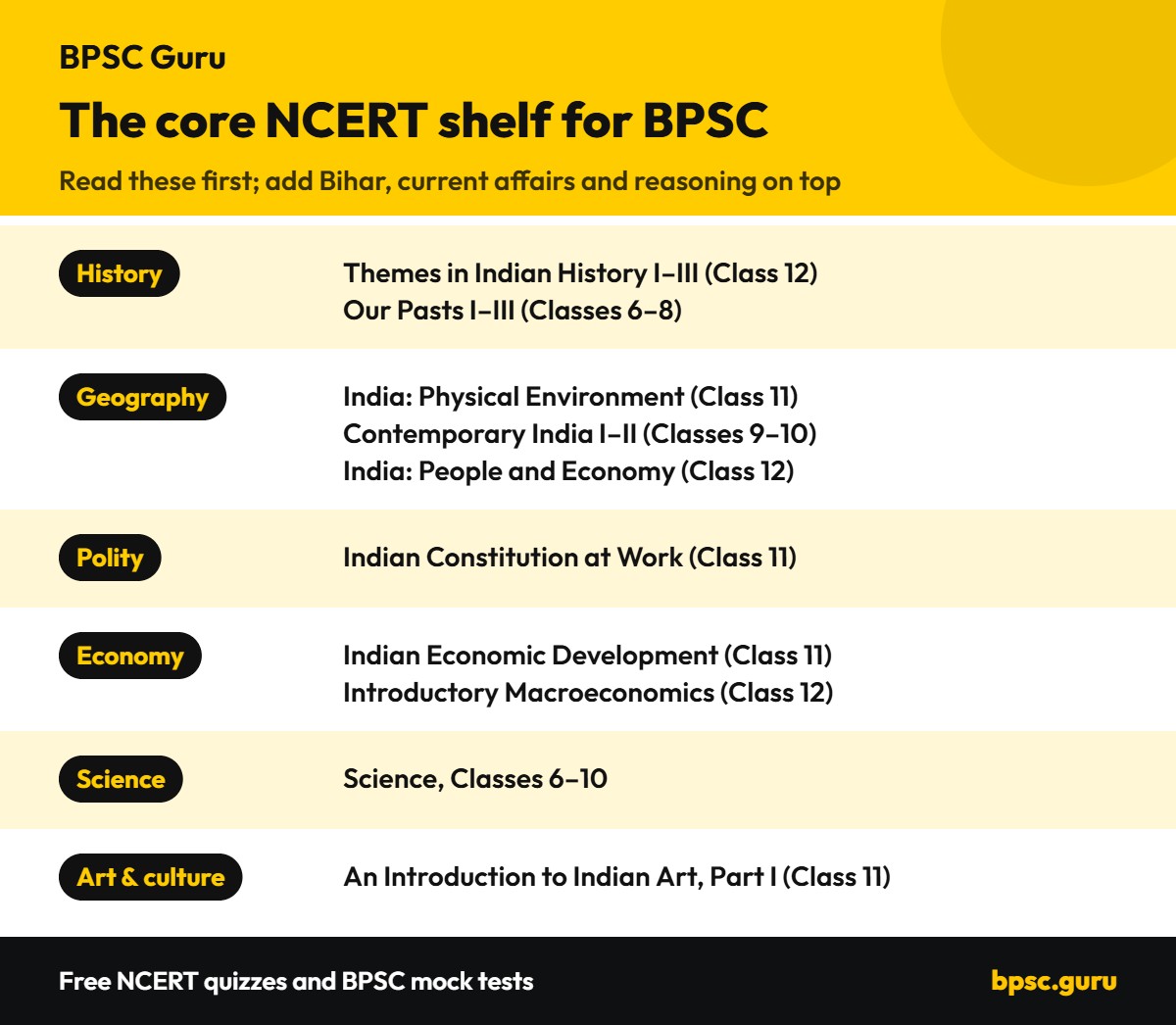
If you read only one shelf, make it this one:
- History: Themes in Indian History Parts I–III (Class 12), backed by Our Pasts I–III (Classes 6–8)
- Geography: India: Physical Environment (Class 11), Contemporary India I–II (Classes 9–10) and India: People and Economy (Class 12)
- Polity: Indian Constitution at Work (Class 11)
- Economy: Indian Economic Development (Class 11) and Introductory Macroeconomics (Class 12)
- Science: Science, Classes 6–10
- Art and culture: An Introduction to Indian Art, Part I (Class 11)
Also, all NCERT textbooks are free to download from the official NCERT website. This guide maps each book to the BPSC syllabus, flags the chapters that matter most for Bihar-focused questions, and explains what NCERT’s new 2024–26 textbooks change. Finally, it ends with a 45-day plan you can follow alongside our NCERT history quizzes.
Why NCERT books work for BPSC
Specifically, NCERTs cover the static base of five of the seven BPSC prelims syllabus areas, at the depth the exam expects. That is because BPSC’s syllabus pitches its questions at a well-educated generalist rather than a subject specialist — exactly the level NCERTs are written for.
| BPSC prelims syllabus area | NCERT base | What to add for BPSC |
|---|---|---|
| History of India and salient features of Bihar’s history | Our Pasts I–III; Themes in Indian History I–III | Bihar’s ancient centres: Magadha, Pataliputra, Nalanda, Vikramshila (see our notes on the 16 Mahajanapadas) |
| Indian National Movement and Bihar’s part in it | India and the Contemporary World I–II; Themes in Indian History III | 1857 in Bihar (Kunwar Singh), Champaran Satyagraha (1917), Bihar in the Quit India Movement (1942) |
| General geography, Bihar’s geographical divisions and river systems | Geography, Classes 6–12 | Bihar’s physiography and rivers — Ganga, Kosi, Gandak, Son, Bagmati — and floods |
| Indian polity and economy; Bihar’s economy since independence | Democratic Politics I–II; Indian Constitution at Work; Indian Economic Development; Introductory Macroeconomics | The latest Bihar Economic Survey; panchayati raj in Bihar |
| General science | Science, Classes 6–10 | Science and technology in the news |
| Current events | — | 12 months of national, international and Bihar news (our current affairs) |
| General mental ability | — | Reasoning and arithmetic practice |
Why the basics decide the prelims
In fact, recent papers reward this base. Analyses of the 71st prelims (September 2025) rated it easy to moderate overall, with Bihar GK and history questions among the easier ones. Because easy questions are the ones every serious candidate gets right, an NCERT gap there costs more than a hard question missed.
The complete class-wise list of NCERT books for BPSC
First, read Classes 6–8 quickly for basics; then treat Classes 9–10 as core and read Classes 11–12 selectively. The table uses the familiar subject-wise titles; the sections below say which chapters to prioritise and how NCERT’s new books fit in.
| Class | History | Geography | Polity | Economics | Science |
|---|---|---|---|---|---|
| 6 | Our Pasts I | The Earth: Our Habitat | Social and Political Life I | — | Science (new: Curiosity) |
| 7 | Our Pasts II | Our Environment | Social and Political Life II | — | Science (new: Curiosity) |
| 8 | Our Pasts III | Resources and Development | Social and Political Life III | — | Science (new: Curiosity) |
| 9 | India and the Contemporary World I | Contemporary India I | Democratic Politics I | Economics | Science (new: Exploration) |
| 10 | India and the Contemporary World II | Contemporary India II | Democratic Politics II | Understanding Economic Development | Science |
| 11 | Themes in World History (optional) | Fundamentals of Physical Geography; India: Physical Environment | Indian Constitution at Work | Indian Economic Development | — |
| 12 | Themes in Indian History I–III | Fundamentals of Human Geography; India: People and Economy | Politics in India since Independence | Introductory Macroeconomics | — |
For art and culture, add the Class 11 Fine Arts book An Introduction to Indian Art, Part I. Meanwhile, for Classes 6–9, NCERT’s new integrated social science books replace the separate history, geography and civics titles — more on that below.
Practise class by class
Test yourself as you finish each book:
- NCERT Class 7 History Quiz for BPSC (60 MCQs)
- NCERT Class 8 History Quiz: 115 Modern India MCQs
- NCERT Class 9 History Quiz: 50 World History MCQs
- NCERT Class 11 History Quiz: World History (50 MCQs)
- NCERT Class 12 History Quiz 1: Colonial India & Constitution
- NCERT Class 12 History Quiz 2: Ancient & Medieval India
NCERT history for BPSC: books and chapters to prioritise
History is where NCERTs pay off most for BPSC, because the syllabus asks for Indian history and Bihar’s place in it. Read each NCERT chapter, then add the Bihar thread that runs through it.
| Period | Prioritise in NCERT | Bihar link to add |
|---|---|---|
| Ancient | Our Pasts I (Class 6), whole book; Themes in Indian History I: “Bricks, Beads and Bones”, “Kings, Farmers and Towns”, “Thinkers, Beliefs and Buildings” | Magadha’s rise (Rajgir, Pataliputra); Bodh Gaya; Vaishali and Pawapuri (Mahavira); Ashokan pillars at Lauriya Nandangarh and Rampurva; Nalanda and Vikramshila |
| Medieval | Our Pasts II (Class 7); Themes in Indian History II: “Through the Eyes of Travellers”, “Bhakti–Sufi Traditions”, “Peasants, Zamindars and the State” | Sher Shah Suri’s reforms (his tomb is at Sasaram); Patna Sahib, birthplace of Guru Gobind Singh |
| Modern | Our Pasts III (Class 8); “Nationalism in India” (Class 10); Themes in Indian History III: “Rebels and the Raj”, “Mahatma Gandhi and the Nationalist Movement” | Kunwar Singh of Jagdishpur in 1857; Champaran Satyagraha (1917); the seven students killed at the Patna Secretariat on 11 August 1942 |
| Art and culture | An Introduction to Indian Art, Part I (Class 11): Mauryan, Gupta and temple art | The polished Didarganj Yakshi, found in Patna and usually studied with Mauryan art; Mithila (Madhubani) painting |
Next, go deeper on the Bihar thread with our notes on the 16 Mahajanapadas, the major dynasties of ancient Bihar and Bihar in the Quit India Movement.
Going beyond the school books
Want more depth? The older NCERT history textbooks by R.S. Sharma (ancient), Satish Chandra (medieval) and Bipan Chandra (modern) are no longer the current school texts, but many BPSC aspirants still use them.
One caution: NCERT has trimmed several textbooks since 2022, so a recent reprint can miss chapters an older edition carries. Compare the contents pages if you are using a borrowed copy.
Finally, test each period as you finish it: NCERT Ancient & Medieval India quiz (80 MCQs), Modern Indian History test (150 MCQs) and Bihar History PYQ (152 questions).
Geography: books and priority chapters
BPSC’s geography questions lean on India’s physical geography and then ask where Bihar fits — its plains, its rivers, its floods. So use NCERT for the India layer, then add the Bihar layer chapter by chapter.
| NCERT book | Prioritise | Bihar link to add |
|---|---|---|
| Contemporary India I (Class 9) | Physical features, drainage, climate, natural vegetation and wildlife | North Bihar’s Himalayan rivers (Ghaghara, Gandak, Burhi Gandak, Bagmati, Kamla, Kosi, Mahananda) vs south Bihar’s peninsular rivers (Son, Punpun, Phalgu, Kiul) |
| Contemporary India II (Class 10) | Soils and land resources, water resources, agriculture, minerals and energy | Alluvial soils, the flood-prone Kosi basin, rice–wheat–maize cropping, makhana (Mithila Makhana holds a GI tag) |
| India: Physical Environment (Class 11) | Structure and physiography, drainage, climate, natural hazards and disasters | Kosi floods; the 1934 Bihar–Nepal earthquake |
| India: People and Economy (Class 12) | Population, land and agriculture, water, mineral and energy resources | Bihar’s population density, the highest of any state in Census 2011 |
| Fundamentals of Physical Geography (Class 11) | Interior of the earth, landforms, atmosphere and oceans — selectively | — |
| Classes 6–8 | Maps, latitude and longitude, motions of the earth, environment basics | — |
Add the Bihar layer with our notes on Bihar’s rivers, floods and agro-climatic zones, then test it with the Bihar Polity & Geography PYQ quiz.
Above all, keep an atlas open while you read. Most geography questions that look hard are really location questions, and a map fixes them faster than notes.
Polity and economy: the books that do the work
For polity, one book does most of the work: Indian Constitution at Work (Class 11). For economy, pair Indian Economic Development (Class 11) with Introductory Macroeconomics (Class 12), then add Bihar’s own numbers.
| NCERT book | Prioritise | Bihar link to add |
|---|---|---|
| Indian Constitution at Work (Class 11) | Making of the Constitution, rights, elections, executive, legislature, judiciary, federalism, local governments | Panchayati raj in Bihar — in 2006 it became the first state to reserve 50% of panchayat seats for women |
| Democratic Politics I–II (Classes 9–10) | Constitutional design, electoral politics, working of institutions, federalism, political parties | — |
| Politics in India since Independence (Class 12) | Nation-building and planned development, read selectively | — |
| Indian Economic Development (Class 11) | The economy at independence, planning from 1950 to 1990, the 1991 reforms, human capital, rural development, employment, sustainable development | Bihar’s growth, sector shares and schemes from the latest Bihar Economic Survey |
| Introductory Macroeconomics (Class 12) | National income, money and banking, government budget, balance of payments | The Bihar state budget’s headline numbers |
| Economics (Class 9) and Understanding Economic Development (Class 10) | Poverty, food security, sectors of the economy, money and credit, globalisation | Rural livelihoods, e.g. the JEEViKA programme |
Don’t skip Bihar’s economy
The BPSC syllabus names Bihar’s economic changes since independence and planning in India and Bihar explicitly, so don’t skip the state layer. The 20th Bihar Economic Survey (2025–26) was tabled in the state Assembly on 2 February 2026. Our notes on Bihar’s economic transition and the Bihar Economy PYQ quiz also cover the state layer.
Science: how far to go
Class 6–10 Science is enough for BPSC’s General Science section. The syllabus asks for the everyday understanding of a well-educated non-specialist, and coaching analyses of the 71st prelims counted roughly 10 to 15 everyday-science questions.
| Area | Topics to prioritise in Classes 6–10 | Typical BPSC angle |
|---|---|---|
| Biology | Human body systems, nutrition and deficiency diseases, microbes and disease, reproduction, heredity | Vitamins, diseases and their causes, the human body |
| Physics | Light and the human eye, electricity and its effects, magnetism, sound, motion and force, work and energy | Everyday applications, units, simple devices |
| Chemistry | Acids, bases and salts; metals and non-metals; carbon compounds; common chemicals such as baking soda and bleaching powder | Household chemistry and uses of substances |
So skip Class 11–12 physics and chemistry. If biology is your weak area, the Class 12 chapter on human health and disease is the one optional extra worth the time.
NCERT’s new science books — Curiosity for Classes 6–8 and Exploration for Class 9 — organise topics differently. Either version works; however, the older Science books are more compact for revision.
Old vs new NCERT books for BPSC: what changed by 2026
For BPSC, keep the older subject-wise books as your base and skim the new ones for fresh angles. NCERT has been replacing its textbooks class by class since 2024, folding history, geography and civics into one integrated social science book per class.
| Class | Older subject-wise books | New integrated book | First released |
|---|---|---|---|
| 6 | Our Pasts I; The Earth: Our Habitat; Social and Political Life I | Exploring Society: India and Beyond | 2024 |
| 7 | Our Pasts II; Our Environment; Social and Political Life II | Exploring Society: India and Beyond, two parts | 2025 |
| 8 | Our Pasts III; Resources and Development; Social and Political Life III | Exploring Society: India and Beyond, two parts | 2025 |
| 9 | India and the Contemporary World I; Contemporary India I; Democratic Politics I; Economics | Understanding Society: India and Beyond, two parts | 2026 |
| 10–12 | The familiar subject-wise series | No new books reported as of October 2026 | — |
What the changes mean for your preparation
Three changes matter for aspirants:
- Periods have moved. The new Class 7 Part 1 (April 2025) covers ancient India up to the Guptas, including Magadha and the Mauryas. The Delhi Sultanate and the Mughals now appear in the new Class 8 Part 1 (July 2025), not in Class 7.
- Subjects are mixed. One volume now carries history, geography, polity and economics, which makes subject-wise revision slower.
- The exam hasn’t changed. BPSC asks about established facts, and almost all previous-year questions were set before these books existed.
So build your base on the older books, which are still widely available second-hand and in libraries. Then read the new Class 6–9 books once, quickly — the new Class 7 chapters on Magadha and the Mauryas are worth it for Bihar’s ancient history alone.
What NCERT books won’t cover for BPSC
NCERTs give you India; BPSC also wants Bihar, the last 12 months and your reasoning speed. So plan for these four gaps from day one.
| Gap | What BPSC asks | What to add |
|---|---|---|
| Bihar-specific static topics | Bihar’s history, geography and administration — e.g. the creation of Bihar and Orissa province in 1912 (Bihar Diwas, 22 March) and the creation of Jharkhand on 15 November 2000 | A dedicated Bihar GK source such as our Bihar GK notes, plus Bihar questions from past BPSC papers |
| Bihar’s economy | Growth, sector shares, budget and state schemes | The latest Bihar Economic Survey (the 20th, for 2025–26) and the state budget |
| Current events | National, international and Bihar news of the past year | A monthly current-affairs compilation and a daily newspaper |
| General mental ability | Reasoning, arithmetic and data interpretation — around 9 to 10 questions in the 71st prelims, per coaching analyses | Timed practice sets, two or three times a week |
Finally, previous-year papers tie it all together. Solve them topic by topic after each NCERT subject, so you see which facts BPSC actually asks for. Start with our Bihar History PYQ, Bihar Polity & Geography PYQ and Bihar Economy PYQ quizzes, then the Bihar Special Mock Test.
How to read NCERT books for BPSC: the three-pass method
Read each chapter three times with a different job each time, and finish every chapter with a test. Reading without testing feels productive but fades within days.
- Pass 1 — understand. First, read the chapter like a story, without notes. Lightly mark names, places, dates and terms.
- Pass 2 — note. Next, make one page of notes per chapter: the facts an MCQ could ask (who, what, where, when). Add a “Bihar” line — what in this chapter connects to Bihar?
- Pass 3 — test. Take a chapter MCQ test straight away, then go back to the book for every wrong answer. Aim for 80% before you move on.
Then re-test each chapter about a week later, from your notes only. In other words, the second test tells you what has actually stuck.
Also, read in the language you will write the exam in. NCERT publishes its textbooks in both Hindi and English, so a Hindi-medium candidate loses nothing by staying in Hindi.
For pass 3, use our NCERT history quizzes and test each chapter the day you finish it.
A 45-day reading plan
At about five hours a day, the core NCERT shelf fits into 45 days with a week left for revision. Studying part-time? In that case, stretch the same sequence over 60 to 90 days.
| Days | Read | Test |
|---|---|---|
| 1–7 | History: Our Pasts I–III (Classes 6–8) | Chapter tests daily; a Bihar history set at the week’s end |
| 8–14 | History: India and the Contemporary World I–II; priority chapters of Themes in Indian History I–III; An Introduction to Indian Art Part I, selectively | Chapter tests; one full history test |
| 15–21 | Geography: Classes 6–10, then India: Physical Environment (Class 11) | Daily map practice; chapter tests |
| 22–28 | Geography: India: People and Economy (Class 12), Fundamentals of Physical Geography selectively; Polity: Democratic Politics I–II | Chapter tests |
| 29–35 | Polity: Indian Constitution at Work; Economy: Classes 9–10, then Indian Economic Development | Chapter tests; Bihar Economic Survey highlights |
| 36–40 | Economy: Introductory Macroeconomics; Science: Classes 6–10 priority topics | Science MCQ sets |
| 41–45 | Revision from your notes; re-read only your weakest chapters | Two full-length mocks, scored the BPSC way |
In addition, keep one hour a day for current affairs and three short reasoning sessions a week throughout. For the final mocks, use BPSC’s real scoring — +1, −1/3 and Option E — explained in our guide to BPSC negative marking and Option E.
Frequently asked questions
Are NCERT books enough for BPSC?
No. They build the static base in history, geography, polity, economy and science, but BPSC also tests Bihar-specific topics, current events and mental ability. So plan separate sources for those three.
Which NCERT books should I read first for BPSC?
Start with history (Our Pasts I–III), then geography (Contemporary India I–II). After that, follow with Indian Constitution at Work and Indian Economic Development.
Should I read old or new NCERT books for BPSC?
Use the older subject-wise books as your base and skim the new Class 6–9 books once. After all, BPSC tests established facts, and nearly all past questions predate the new books.
Do NCERT books cover Bihar GK?
Only in passing. Bihar’s history, geography and economy therefore need a dedicated Bihar source, previous BPSC papers and the latest Bihar Economic Survey.
Which NCERT is best for BPSC history?
Themes in Indian History Parts I–III (Class 12), with Our Pasts I–III (Classes 6–8) for basics. For art and culture, add An Introduction to Indian Art, Part I (Class 11).
Should I read NCERTs in Hindi or English for BPSC?
In the language you will take the exam in, because NCERT publishes its textbooks in both.
Where can I download NCERT books for free?
From the official NCERT website.
How long does it take to finish NCERTs for BPSC?
About 45 days for the core shelf at five hours a day, or 60 to 90 days if you study part-time.
The bottom line
The right NCERT books for BPSC are a selective shelf, not the whole syllabus: history, geography, polity, economy and science from Classes 6–12, read in three passes and tested chapter by chapter. Then add Bihar, current events and reasoning on top, and you have covered most of what the prelims asks.
Start today with Our Pasts I, then take our NCERT Ancient & Medieval India quiz. Follow the 45-day plan above one chapter and one test at a time, and use the free BPSC mock test series for full-length practice.
Sources
- NCERT textbooks (official downloads)
- iDream Education: NCERT changes for 2024–25 (Class 6)
- Scroll: new NCERT Class 7 textbook (April 2025)
- India TV: new NCERT Class 8 social science textbook (July 2025)
- Learn CBSE: NCERT Class 8 science, Curiosity
- AglaSem: NCERT press release on Class 9 textbooks for 2026–27
- eSaral: Class 9 Understanding Society: India and Beyond chapters
- SelfStudys: Class 9 social science Part 2 released
More on BPSC Guru
- 72nd BPSC 2026: notification, vacancies and exam date
- BPSC syllabus and exam pattern 2026
- All free BPSC mock tests and quizzes
- BPSC negative marking and the Option E rule
 Harsha