
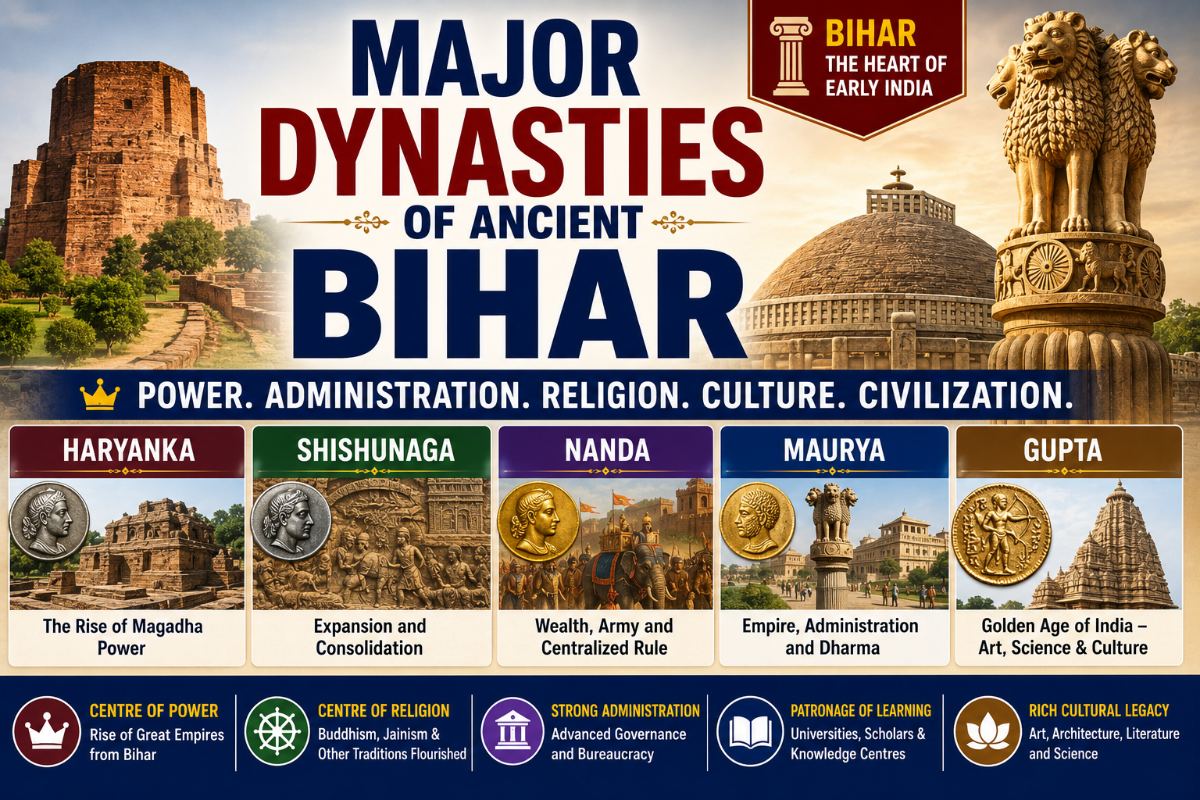
Major Dynasties of Ancient Bihar
This topic sits under “History of India with special reference to Bihar” in the BPSC syllabus; practise it in the Bihar special mock test and the Bihar history PYQ, and check the 72nd BPSC 2026 page for the prelims date.
Haryanka Dynasty
The Haryanka dynasty was the first important ruling dynasty of Magadha. Its rise marks the beginning of Magadha’s growth into a major power. The most well-known ruler of this dynasty was Bimbisara, who made Rajgir his capital and strengthened the kingdom through diplomacy and conquest. He expanded Magadha’s power and maintained friendly relations with contemporary religious leaders. His son Ajatashatru further expanded the kingdom and made Magadha stronger militarily. The Haryanka rulers supported the early rise of both Buddhism and Jainism.
Shishunaga Dynasty
The Shishunaga dynasty succeeded the Haryankas and continued the process of Magadha’s expansion. Shishunaga was the founder of this dynasty. The capital was shifted from Rajgir to Vaishali for a time, showing political changes within the region. This dynasty is important because it defeated the powerful Avanti kingdom and made Magadha the dominant force in north India. It also strengthened the administrative and military base of the state.
Nanda Dynasty
The Nanda dynasty came after the Shishunagas and made Magadha even more powerful. The founder of the dynasty was Mahapadma Nanda, who is remembered for his great military strength and vast territorial expansion. The capital remained at Pataliputra, which became one of the most important political centres of ancient India. The Nandas are known for building a strong centralised state and for their huge treasury and army. Their rule prepared the ground for the Mauryan Empire.
Maurya Dynasty
The Maurya dynasty was the greatest ancient dynasty of Bihar and one of the most powerful empires in Indian history. Its founder was Chandragupta Maurya, and its capital was Pataliputra. Under Chandragupta and later Ashoka, the Mauryan Empire expanded across most of the Indian subcontinent. The Mauryas are remembered for their strong administration, efficient revenue system, and imperial unity. Ashoka’s patronage of Buddhism gave Bihar a special place in world history. Pataliputra became a symbol of political greatness and administrative excellence.
Gupta Dynasty
The Gupta dynasty is often called the “Golden Age” of ancient India. Though the Guptas ruled over a large part of north India, Bihar remained one of their important centres. Chandragupta I is considered the founder of the dynasty, and Pataliputra continued to be a major capital and administrative centre. The Guptas are remembered for achievements in literature, science, mathematics, art, and philosophy. They patronized Sanskrit learning and helped Indian culture reach a high point of excellence.
Importance of Capitals
The changing capitals of these dynasties show the political importance of Bihar. Rajgir, Vaishali, and Pataliputra were not just administrative centres but also centres of trade, religion, and culture. Rajgir was an early political base, Vaishali represented the power of the confederate system for a time, and Pataliputra emerged as the greatest imperial capital of ancient India. The shift of capitals also reflects the expansion of political power and the growing complexity of administration.
Religious Patronage
These dynasties are also important because they supported different religions. The Haryankas and later rulers patronized Buddhism and Jainism. The Mauryas, especially Ashoka, gave extraordinary support to Buddhism. The Guptas supported Hinduism and Sanskrit culture, though they also tolerated other traditions. This religious patronage helped Bihar become a land of intellectual diversity and spiritual development.
Conclusion
Ancient Bihar was ruled by several important dynasties that shaped the history of India. They built powerful kingdoms, shifted capitals, expanded administration, and supported religion and culture. From the Haryankas to the Guptas, each dynasty contributed to Bihar’s rise as a centre of power and civilization. Their legacy remains deeply connected with India’s ancient political and cultural history.
Related reading
- Great Personalities of Bihar: Leaders, Reformers & Poets
- 16 Mahajanapadas: Magadha, Vajji & Anga (BPSC Notes)
- Western & Technical Education in Bihar: Colonial Era (BPSC)
- Bihar in the Quit India Movement 1942: Azad Dasta & More
- All Bihar GK posts
- The full list of free BPSC mock tests and quizzes
- 72nd BPSC 2026: notification, vacancies and exam date
- BPSC syllabus and exam pattern 2026