
BPSC negative marking no longer punishes only wrong answers. Since BPSC’s May 2026 notice, every objective-type BPSC exam carries a fifth bubble, Option E, which means “Not Attempted”. Leave a row completely blank and you lose 1/3 of a mark — exactly what a wrong answer costs.
That changes how you should handle every doubtful question in the 72nd Combined Competitive Examination (CCE) prelims, which BPSC first listed for 26 July 2026 in its official exam calendar, then moved to 25 October 2026 after a postponement in July, and postponed again by a notice of 12 October 2026; the new date is still to be announced, so keep an eye on bpsc.bihar.gov.in and the 72nd BPSC page, which lists the official notices, for the new date and the admit card.
This guide explains the rule, works through the guessing maths with real numbers and gives you an exam-day OMR plan. It ends with a three-week routine you can rehearse on our free BPSC mock tests, which already use BPSC-style scoring.
BPSC negative marking in 30 seconds
| What you do on the OMR sheet | Marks for that question |
|---|---|
| Bubble the correct answer (A, B, C or D) | +1 |
| Bubble a wrong answer (A, B, C or D) | −1/3 (−0.33) |
| Bubble E (Not Attempted) | 0 |
| Leave the row completely blank | −1/3 (−0.33) |
The one rule to remember: never leave a row blank. Bubble an answer, or bubble E.
What changed in 2026: the Option E rule
BPSC now wants a deliberate decision on every single question. Until 2026, a blank row simply scored zero. Under the new rule, a blank row is scored like a wrong answer, and Option E is the only penalty-free way to skip.
- What Option E means: “Not Attempted”. It is a skip bubble, not an answer choice. Questions still have four answer options, A to D.
- When it was announced: May 2026, through a BPSC notice covering all of its objective-type exams.
- First exam under the rule: the 33rd Bihar Judicial Services (Preliminary) exam on 3 June 2026.
- Extra time: that first exam got 10 extra minutes for the General Studies paper and 15 for the Law paper. BPSC said later exams will not get this extra time.
- Which exams it covers: every objective-type (MCQ) exam BPSC conducts — so the 72nd CCE prelims is included.
Don’t confuse this with older papers. Some earlier BPSC papers used a fifth option that meant “None of the above” or “More than one of the above”. In 2026 papers, E is never the answer to a question; it only records that you skipped it.
The practical effect: there is no extra time to tidy up the OMR sheet. Bubbling E for every skipped question now has to fit inside your two hours.
BPSC 72nd CCE marking scheme at a glance
The prelims is a single 150-mark screening paper, and every mark you protect from negative marking counts towards clearing the cutoff.
| Feature | 72nd CCE Prelims |
|---|---|
| Paper | One paper: General Studies |
| Questions and marks | 150 MCQs, 1 mark each, 150 marks |
| Duration | 2 hours |
| Mode | Offline, OMR sheet |
| Choices per question | A, B, C, D — plus E for Not Attempted |
| Wrong answer | −1/3 mark |
| Blank row | −1/3 mark |
| Counts in final merit? | No — it only decides who reaches the Mains |
The Mains is where your rank is decided. Final merit is out of 1,020 marks: GS Paper I (300), GS Paper II (300), Essay (300) and the Interview (120). General Hindi (100 marks) is qualifying at 30%, and the optional subject is a 100-mark objective-type qualifying paper.
Because the optional paper is also objective-type, expect the same OMR rule there. Read that paper’s instructions on exam day.
The maths of guessing under BPSC negative marking
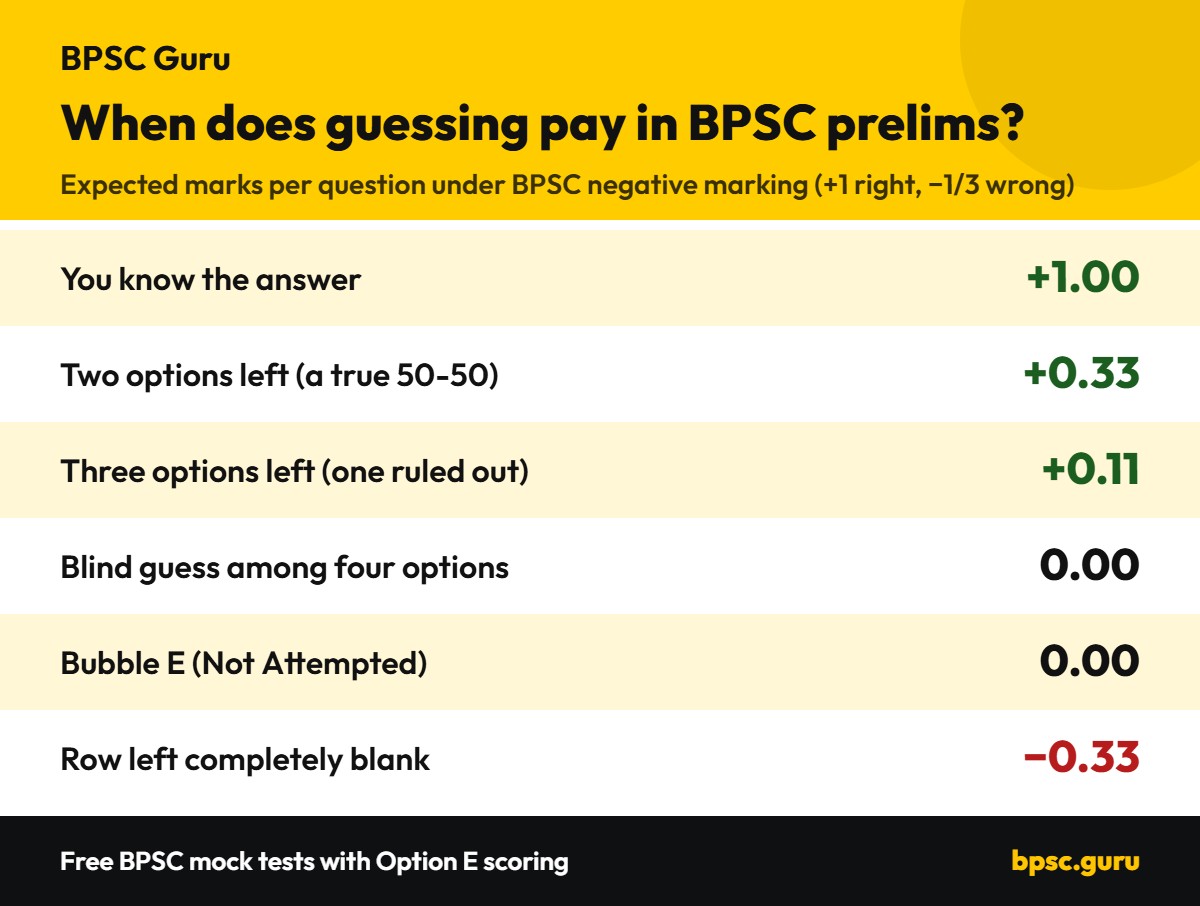
Under BPSC negative marking, an attempt pays off on average whenever your chance of being right is above 25%. With +1 for a right answer and −1/3 for a wrong one, a blind guess among four options breaks exactly even.
The calculation for any question is simple: expected marks = (chance right × 1) − (chance wrong × 1/3). Here is what it gives as you rule out options.
| Your situation | Chance of being right | Expected marks per question | What to do |
|---|---|---|---|
| You know the answer | 100% | +1.00 | Attempt |
| Down to 2 options (a true 50-50) | 50% | +0.33 | Attempt |
| Ruled out 1 option, 3 left | 33% | +0.11 | Attempt only if the elimination is solid |
| No idea, blind guess among 4 | 25% | 0.00 | Mark E — a guess adds risk, not marks |
| Bubble E | — | 0.00 | Safe skip |
| Leave the row blank | — | −0.33 | Never |
Three things follow from this table:
- A blank row is the worst option on the sheet. It costs a certain 1/3 mark; bubbling E costs nothing, and even a blind guess costs nothing on average.
- The 50-50s are where marks are won. Each true 50-50 is worth about +1/3 mark on average. Ten of them add roughly 3.3 marks — and prelims cutoffs are often crossed or missed by margins that small.
- Your elimination must be honest. BPSC distractors are written to look right. If you only feel that an option is wrong, treat the question as a blind guess and bubble E.
Guessing also adds variance. On a single question the outcome is +1 or −1/3, never the average. Across 20 to 30 genuine 50-50s, though, the average is what you should expect.
Save this summary for revision day:
Worked example: the same knowledge, four different scores
On identical knowledge, attempt strategy alone can move a prelims score by more than 12 marks under BPSC negative marking. Take one illustrative candidate who sorts the 150 questions into four buckets.
| Bucket | Questions | Assumed accuracy | Expected net marks |
|---|---|---|---|
| Sure | 90 | 90% (81 right, 9 wrong) | 81 − 3 = 78.00 |
| True 50-50 | 30 | 50% (15 right, 15 wrong) | 15 − 5 = 10.00 |
| One option ruled out | 20 | 33% (6.67 right, 13.33 wrong) | 6.67 − 4.44 = 2.22 |
| No idea | 10 | — | 0 if bubbled E |
Now compare four ways the same candidate could fill the OMR sheet.
| Strategy | Expected score (out of 150) |
|---|---|
| Attempt sure questions only, E for the rest | 78.00 |
| Sure + 50-50s, E for the rest | 88.00 |
| Sure + 50-50s + one-ruled-out, E for no-idea | 90.22 |
| Same as above, but 10 rows left blank instead of E | 86.89 |
For scale, the 71st CCE prelims cutoff for unreserved male candidates was 88.00. Male cutoffs were 84.00 for BC, 82.33 for EWS, 81.00 for EBC, 72.00 for SC and 71.33 for ST; cutoffs for women were lower.
The 72nd cutoff will differ, and real scores vary around these averages. The lesson holds anyway: attempt your 50-50s, skip true unknowns with E, and never lose marks to blank rows.
How many questions should you attempt in BPSC prelims?
There is no safe fixed number: attempt every question you can place in a winning bucket, and nothing else. Coaching analyses put “good attempts” in the 71st prelims at roughly 115 to 125, but that range describes other candidates’ knowledge, not yours.
Use four quick marks in the question booklet as you read each question:
- ✓ Sure — bubble it in your next OMR block.
- ½ Two left — attempt it; a true 50-50 is worth +0.33 on average.
- ⅓ One ruled out — attempt only if you can say why that option is wrong.
- ✗ No idea — bubble E in the final sweep.
Accuracy beats volume. A candidate who attempts 125 questions at 80% accuracy expects about 91.7 marks. One who attempts 140 at 72% accuracy expects about 87.7 — fewer marks from more attempts.
Measure your own accuracy in mocks before exam day. If your ½ guesses come out right about half the time or better, your eliminations are sound. If the hit rate slides towards one in four, they are no better than blind guesses — bubble E more often.
Exam-day OMR plan for the 120 minutes
Reserve the last 12 minutes for the OMR sheet alone, because with no extra time, a late rush is where blank rows — and lost thirds of a mark — come from.
- 0–5 min: set up. Fill your roll number, booklet series and signature exactly as instructed. Flip through the booklet for missing or misprinted pages.
- 5–65 min: first pass. Answer every ✓ question. Mark ½, ⅓ and ✗ in the booklet and move on. After every 10 questions, bubble that block’s ✓ answers on the OMR.
- 65–95 min: second pass. Return to the ½ questions and decide them. Then work through the ⅓ questions, keeping only the ones where you can name a wrong option.
- 95–108 min: third pass. Take on leftover calculation or reasoning questions if time allows. Anything still ✗ now gets E.
- 108–118 min: OMR sweep. Bubble every remaining answer, then E for every untouched row. Check each block of 10: question number and row must match.
- 118–120 min: final check. Scan for any row with no bubble, or with two bubbles. Fill any blank row with E, and never try to correct a bubbled row by overwriting it.
Two rules for the sheet itself. Don’t bubble E early on a question you plan to revisit — a darkened bubble cannot be undone. And never darken two bubbles in one row; follow the admit card’s pen and marking instructions to the letter.
Seven OMR mistakes that cost marks under BPSC negative marking
Most marks lost to the new rule will come from habits, not knowledge.
- Leaving rows blank “to come back later” and running out of time. Each one costs 1/3 mark.
- Bubbling E too early on a question you later solve. You cannot un-darken it.
- Reading E as an answer. E is never “None of the above” in the new format; it only records a skip.
- Blind guessing because “it might be right”. At four options a blind guess earns nothing on average and adds risk.
- Trusting a shaky elimination. Statement-based questions often hide the right answer behind a plausible-looking wrong one.
- Shifting rows. Skip one row while bubbling and every answer after it lands in the wrong place. Bubble in blocks of 10 and match numbers.
- Practising without negative marking. Mocks scored only +1 train you to over-attempt. Score your mocks the BPSC way: +1, −1/3 and E.
Practise BPSC negative marking: a 3-week mock plan
Rehearse the bucket method and the OMR sweep at least eight times before the real exam, so that on the day it runs on habit. Print a 150-row OMR sheet with five bubbles per row and use it for every full mock.
| Week | Study focus | Mocks | What to track |
|---|---|---|---|
| Week 1 | History, Polity, Geography, Bihar-specific topics | Full mock every 2nd day, plus daily topic tests | Net score, accuracy, E-count |
| Week 2 | Weak areas from week 1; current affairs of the last 12 months; mental ability speed | Full mock every 2nd day | ½-bucket hit rate |
| Week 3 | Revision from your own notes only | Full mock on alternate days, timed to your admit-card slot | Rows left blank: must be zero |
After each mock, log four numbers: net score, accuracy (right ÷ attempted), how many E’s you bubbled, and how many of your ½ guesses were right.
bpsc.guru mock tests already apply BPSC negative marking — +1 for a right answer, −1/3 for a wrong one, and an (E) Not attempted button that costs nothing. Start with these:
- 72nd BPSC Mock Test: 100 GS Questions with Answers
- Modern Indian History MCQs for BPSC: 150-Question Test
- Bihar Special Mock Test 2026: 100 Bihar GK Questions
- BPSC GS Mock Test: 50 High-Priority Questions
Short of time for the basics? Read our guide to NCERT books for BPSC first.
Frequently asked questions
Option E is the “Not Attempted” bubble on BPSC OMR sheets. Bubbling it scores 0, and it is the only penalty-free way to skip a question.
Yes. A wrong answer costs 1/3 mark, and so does a row left completely blank.
You lose 1/3 mark, the same as for a wrong answer. Bubble E instead and that question scores zero.
Yes. BPSC applies it to all of its objective-type exams, starting with the 33rd Bihar Judicial Services prelims on 3 June 2026. Follow the instructions printed on your admit card and question booklet.
Guess only when you can rule out at least one option for a clear reason. A blind guess among four options scores zero on average, while a true 50-50 is worth about +0.33.
No. Extra time was given only at the first exam held under the rule, and BPSC said later exams would not get it.
No. The prelims only screens candidates for the Mains. Final merit uses GS Paper I, GS Paper II, Essay and Interview marks — 1,020 in total.
As many as you can honestly place in the sure or 50-50 buckets. Analyses of the 71st prelims put good attempts at about 115 to 125, but your own mock accuracy is the better guide.
The bottom line
Under the 2026 rule, BPSC negative marking rewards decisiveness and punishes drift. Attempt what you know, attempt your true 50-50s, bubble E for real unknowns, and leave no row blank.
None of this works if you meet it for the first time in the exam hall. Take your next full-length test the BPSC way on our free BPSC mock test series, and track your ½-bucket hit rate from day one.
Sources
- BPSC exam calendar (official)
- Patna Press: BPSC brings back Option E
- Business Standard: BPSC 71st CCE prelims result and cut-offs
- Aaj Tak: BPSC updated exam calendar (August 2026)
More on BPSC Guru
- 72nd BPSC 2026: notification, vacancies and exam date
- BPSC syllabus and exam pattern 2026
- All free BPSC mock tests and quizzes
- BPSC negative marking and the Option E rule
 Harsha