
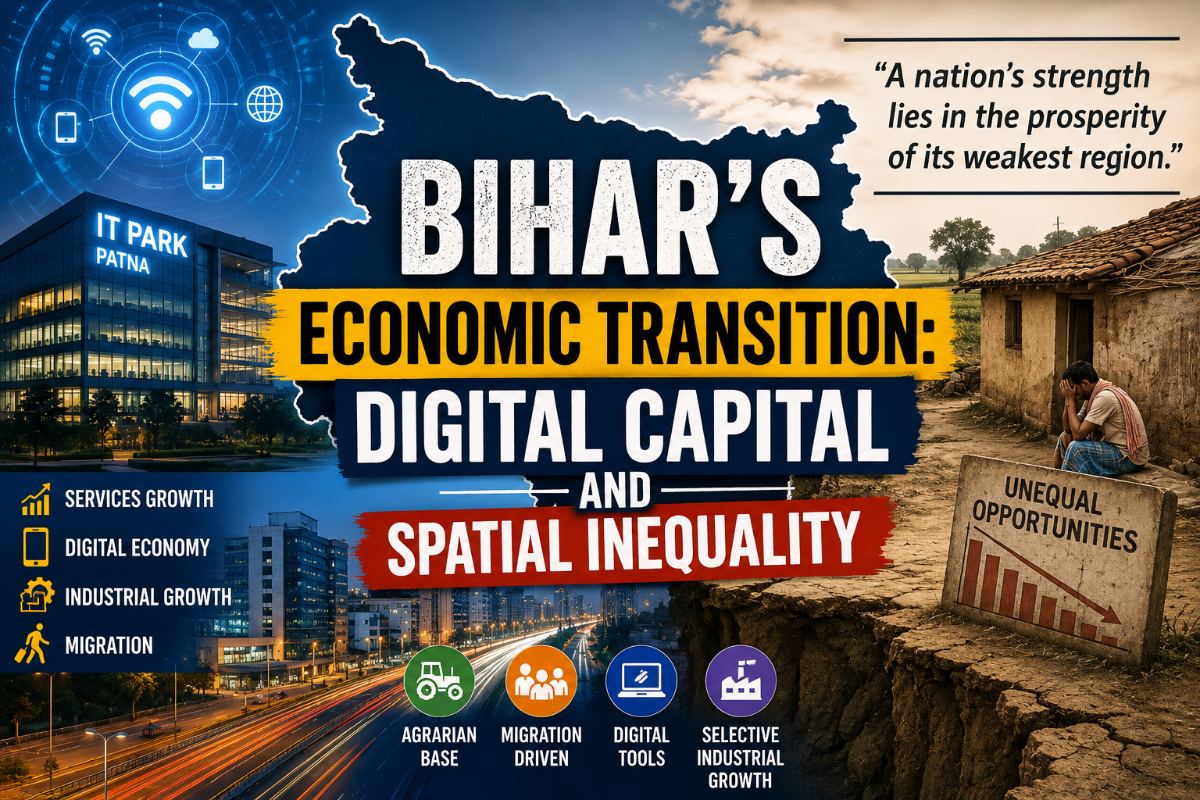
“A nation’s strength lies in the prosperity of its weakest region.” Bihar’s economy reminds us why this line matters. The state is moving away from a purely agrarian base toward a mixed economy shaped by services, migration, digital tools, and selective industrial growth, but this transition has not been evenly shared across districts and social groups.
Bihar’s economic change is visible in daily life. Villages now use digital payments, small traders depend on smartphones, students study online, and migrants send money home faster than ever before. Yet the benefits of this shift are concentrated in a few urban centres, while many rural districts still struggle with weak infrastructure, low industrial presence, and limited local jobs.
Economic Transformation at a Glance
| Economic Dimension | Core Details & Operational Realities |
|---|---|
| Structural Base | Shifting from purely agrarian foundations toward a services, digital, and remittance-led mixed economy. |
| Technological Framework | Rapid baseline adoption of smartphones and UPI, highlighted by national initiatives like Digital India. |
| Spatial Imbalance | A pronounced core-periphery divide where growth centers thrive while interior rural districts lag. |
| Labor Dynamics | Heavy reliance on external migration to sustain rural household consumption via cash remittances. |
From Farm Economy to Mixed Growth
For decades, Bihar depended mainly on agriculture. Land, monsoon, and rural labour shaped the economy. That foundation still matters, but it no longer explains the full picture. Construction, transport, education, retail, digital services, and remittances now form an important part of economic activity, as increasingly reflected in macroscopic assessments from the Finance Department, Government of Bihar.
A shopkeeper in a district town who once worked only in cash may now accept UPI, buy goods online, and use social media to attract customers. This is how digital capital enters the economy. The change is small at the local level, but large in its long-term effect.
“Technology is best when it brings people together.” In Bihar, technology is bringing new opportunities, but not at the same speed everywhere.
Digital Capital and AI
Digital capital is now a major force in Bihar’s growth story. It includes smartphones, internet access, online payments, and digital platforms. These tools are expanding access to education, business, and communication.
Artificial intelligence will matter even more in the coming years. It can support education, administration, content work, healthcare, and business services. But AI can also widen inequality if skill and access remain limited to urban groups. A student in Patna using AI tools for study and work has an advantage that a poorly connected rural student may not yet have. That is why the real issue is not just digital adoption; it is digital inclusion.
Regional Inequality in Bihar
Regional inequality means that some parts of Bihar move ahead much faster than others. Patna, Gaya, Muzaffarpur, Bhagalpur, and a few other centres have better roads, institutions, markets, and job access. Many interior districts still face poor connectivity, fewer industries, and stronger dependence on migration.
This creates a two-speed economy. One part of Bihar is linked to digital growth and services. The other part still depends heavily on agriculture and outmigration. A clear example is education and employment. A student in an urban district may have coaching, internet, transport, and networking. A student in a remote district may have talent, but fewer chances. The gap is not in ability; the gap is in opportunity.
Migration and Income Imbalance
Migration is one of the clearest signs of Bihar’s uneven growth, drawing ongoing structural analysis from national institutions like NITI Aayog. For many years, workers have left the state in search of jobs. Their remittances support households, but they also show that Bihar has not created enough employment locally.
“Where you see migration in large scale, you also see development in incomplete form.” That sentence fits Bihar strongly. A state cannot call its transition successful if its youth must leave to earn. Migration gives families income, but it does not replace industrial development. It also means that the local economy loses labour, skills, and energy.
Growth Without Balance
Bihar’s transition is visible, but the gains are not spread equally. Agriculture still employs many people, but productivity remains low. Industry is not large enough to absorb surplus labour. Services are growing, but mostly in selected pockets.
This is the core of the inequality problem. Growth exists, but it is uneven in geography and social reach. Development becomes stronger when every region gets roads, schools, skill training, electricity, and job opportunities. Without that, economic transition remains incomplete.
Conclusion
Bihar’s economic story is one of movement without full balance. The state is no longer only an agricultural economy; it is entering a digital and service-driven phase. But regional inequality continues because opportunities are concentrated in a few places and not yet distributed widely. The real test for Bihar is whether digital growth, AI, and new economic activity can become inclusive enough to lift the whole state, not just its strongest districts.
Frequently Asked Questions (FAQs)
Q1. How is Bihar’s economy transitioning away from its traditional model?
Bihar is shifting from a purely agrarian economic foundation to a mixed economy. While agriculture remains essential, a massive portion of economic activity is now driven by retail, construction, transportation, digital services, and financial remittances sent by out-of-state workers.
Q2. What is the distinction between digital adoption and digital inclusion in the state?
Digital adoption refers to the overall spread of technology like smartphones and mobile internet across the state. Digital inclusion, however, emphasizes ensuring that rural and marginalized areas gain equal access to high-tier opportunities, advanced skills, and tools like AI, rather than concentrating advantages solely within urban centers.
Q3. Why does high outmigration create an economic imbalance in Bihar?
While outmigration brings critical remittance income directly into local households, it underlines a deficit in local industrial presence and job creation. This reliance causes the local economy to lose critical youth labor, technical skills, and entrepreneurial energy over time.
Related reading
- Bihar in the Quit India Movement 1942: Azad Dasta & More
- Bihar Geography: Rivers, Floods & Agro-Climatic Zones
- Tribal & Peasant Movements in Bihar (1855–1947): BPSC Notes
- Western & Technical Education in Bihar: Colonial Era (BPSC)
- All Bihar GK posts
- The full list of free BPSC mock tests and quizzes
- 72nd BPSC 2026: notification, vacancies and exam date
- BPSC syllabus and exam pattern 2026