
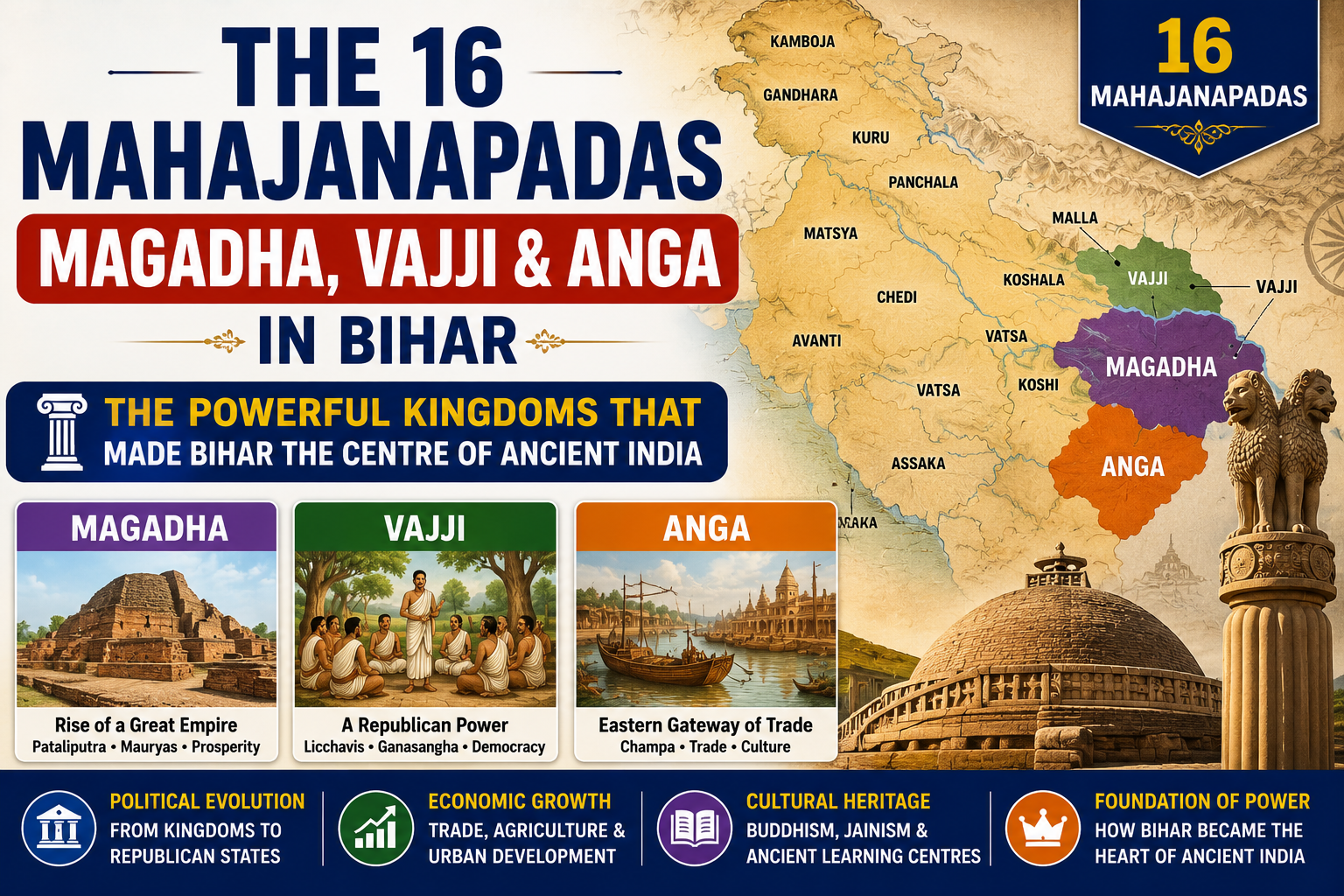
The 16 Mahajanapadas: Magadha, Vajji, and Anga in Bihar
Introduction
By the sixth century BCE, the small tribal states and kingdoms of the earlier period had developed into larger political units called Mahajanapadas. These were important because they represented the growth of agriculture, trade, urban centres, and stronger political authority. Bihar had a central place in this process because Magadha, Vajji, and Anga were all located here or in the nearby region.
Magadha
Magadha was the most powerful and successful among all the Mahajanapadas. Its early capital was Rajgir, and later Pataliputra became the centre of imperial power. Magadha became strong because of its fertile land, control over trade routes, availability of iron ore, and strong rulers. The kingdom was ruled by great kings such as Bimbisara, Ajatashatru, and later rulers who expanded its power. Magadha also benefited from the support of important religious movements, especially Buddhism and Jainism. Its rise marked the beginning of large-scale imperial formation in ancient India.
Vajji
Vajji was one of the important republican mahajanapadas. Unlike monarchies such as Magadha, Vajji had a confederate system in which power was shared by several clans. Its capital was Vaishali. The Vajji confederacy is important because it shows that political organisation in ancient India was not limited to kingship alone. It had a more collective form of governance. This made Vajji historically important in discussions of early republican traditions. Vaishali also became a major centre of Buddhism and Jainism, which adds to its cultural importance.
Anga
Anga was another important Mahajanapada located in the eastern part of Bihar. Its capital was Champa, which was a major trade centre. Anga was known for its commercial importance and strategic location. It often came into conflict with Magadha and was eventually absorbed into it. Even though Anga was later conquered, it played an important role in the economic and political life of eastern India. Its trade links made it a significant part of ancient Bihar’s history.
Why these Mahajanapadas mattered
The Mahajanapadas were important because they show the transition from small tribal units to larger and more organised states. They also reflect the growth of agriculture, iron technology, trade, and urbanisation. In Bihar, this process was especially visible in Magadha, Vajji, and Anga. These states became centres of political competition, and their rivalry helped shape the future of Indian history.
Administrative and political structure
Magadha had a monarchic system with strong central authority. Vajji had a republican or confederate structure where several clans shared power. Anga was also a monarchy but was smaller and less powerful than Magadha. This variety in political forms makes the Mahajanapada period very important for understanding the early history of governance in India. It shows that different systems of administration existed side by side.
Geographical importance
The geography of Bihar helped these states grow. Magadha had fertile plains and strategic river routes. Vajji, located north of the Ganga, had important river connections and fertile regions. Anga, in the eastern part, was connected to trade and communication routes. The rivers Ganga, Son, and other tributaries helped transport goods and support settlements. This geographical advantage was one reason for the rise of these mahajanapadas.
Conclusion
The 16 Mahajanapadas were a major stage in ancient Indian history, and Bihar played a central role in that stage. Magadha became the most powerful kingdom, Vajji represented the republican tradition, and Anga contributed to trade and regional politics. Together, they show how Bihar emerged as the centre of power, administration, and civilization in early India.