
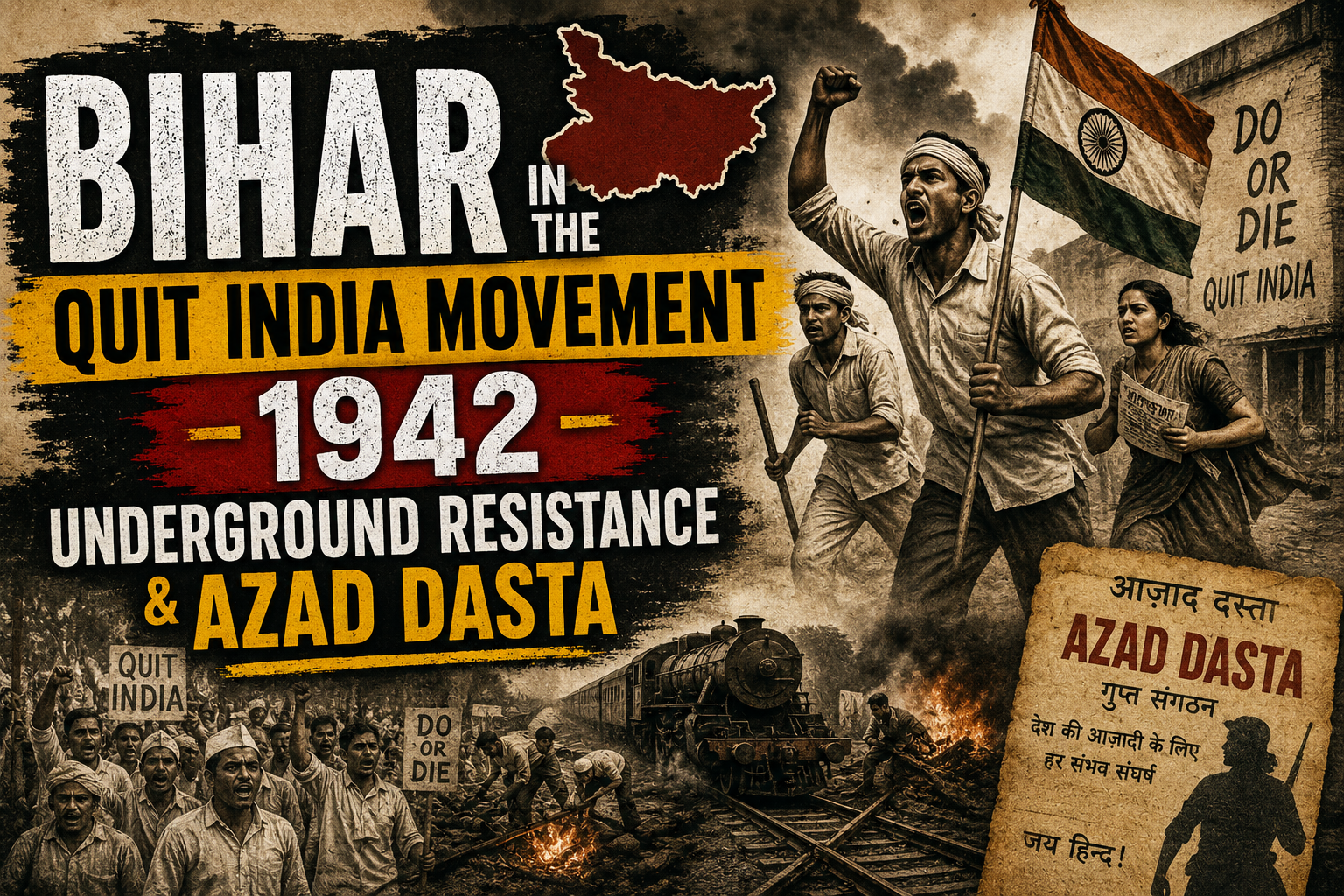
Bihar in the Quit India Movement 1942: Underground Resistance & Azad Dasta
“Do or Die” was not just a political slogan in 1942; in Bihar, it became a literal method of struggle. When the Quit India Movement erupted, Bihar immediately emerged as one of the most active centers of underground resistance, fiercely carrying the national freedom struggle forward even after the top national leadership was summarily arrested.
The state’s role was historically remarkable because it seamlessly combined raw courage, meticulous organization, and vast mass support. Students, youth, peasants, and local grassroots activists effectively turned Bihar into a relentless battleground of political defiance against colonial rule.
1942 Resistance at a Glance
| Historical Aspect | Core Detail |
|---|---|
| Defining Phase | Quit India Movement (August 1942) |
| Key Leadership | Jayaprakash Narayan (Underground network organizer) |
| Resistance Force | Azad Dasta (Secret, militant, and disciplined action group) |
| Core Demographics | Massive participation from students, youth, and rural villagers |
A Movement Without Open Leadership
The Quit India Movement officially began on 8 August 1942, but the British administration moved swiftly to arrest major national leaders almost overnight. That sweeping crackdown left the movement without open, visible direction in many regions across the country. Bihar, however, absolutely refused to go silent.
Jayaprakash Narayan became the most important, enduring symbol of this phase. He successfully escaped arrest and worked tirelessly through underground channels to keep the flames of resistance alive. His leadership gave Bihar a rare and distinct place in modern history: a state where the independence movement survived entirely through secrecy, discipline, and unimaginable courage.
“Freedom is never voluntarily given by the oppressor; it must be demanded by the oppressed.” That foundational idea fits Bihar’s 1942 struggle perfectly.
Jayaprakash Narayan and Underground Action
Jayaprakash Narayan did not remain a distant, philosophical leader; he became the master organizer of hidden resistance. He directly inspired factory workers, university students, and village volunteers to continue the fight through secret communication networks, underground messaging, and stealthy local mobilization.
His greatest strength lay in turning chaotic public anger into an organized structure. When public meetings were strictly banned, underground work kept the movement breathing. When established leaders were jailed, fresh local faces bravely stepped forward. Bihar proved to the nation that leadership in a freedom struggle is not only about speaking loudly on a stage; it is fundamentally about staying active and organized when silence is forced upon you.
The Azad Dasta (The Freedom Brigade)
One of the most powerful and enduring symbols of Bihar’s Quit India struggle was the Azad Dasta. It represented the militant, deeply secret, and highly disciplined side of the anti-colonial resistance.
Members of the Azad Dasta actively carried out critical operations:
- Transporting secret messages across district lines.
- Providing safe shelter for hunted political activists.
- Executing strategic plans to break colonial control and disrupt administration.
- Supporting and funding broader underground operations.
The very name “Azad Dasta” reflected the unyielding spirit of the time. It served as a stark reminder that freedom was being pursued not only through peaceful protest but through highly organized, direct action. In a period of brutal police repression, secrecy itself became a formidable weapon.
Students and Youth at the Front
Bihar’s students played an instrumental role in sustaining the movement. Schools and colleges effectively transformed into epicenters of political energy. Young people abandoned their classrooms and joined the struggle with remarkable speed and dedication.
This youth participation gave the movement its critical urgency. A generation that had grown up entirely under colonial rule now demanded direct action. Many students acted as essential messengers, local organizers, and front-line protest volunteers. Their fearless role made the movement socially wider and politically much stronger.
“The youth are the hope of our future.” In 1942 Bihar, that hope physically manifested as resistance.
Mass Support from Villages and Towns
Crucially, Bihar’s Quit India Movement did not remain confined to urban cities. The sprawling villages and small towns provided it with shelter, physical strength, and vital emotional support. Everyday people hid activists in their homes, passed on crucial intelligence, and resisted British authority in small, everyday ways.
This grassroots support was the backbone of the resistance. An underground movement can only survive when ordinary people implicitly trust it—and Bihar’s villagers and town residents gave that trust unconditionally. That is exactly why the movement here remained alive even under the harshest imperial repression.
The strategic disruption of railways, the cutting of communication lines, and widespread local defiance all compounded the pressure on the colonial administration. The British could arrest the leaders, but they quickly realized they could not easily stop an entire society determined to resist.
Why Bihar Stood Out
Bihar stood out prominently in the national Quit India Movement because it successfully synergized four powerful elements:
- The visionary, underground leadership of Jayaprakash Narayan.
- The militant, structured organization of the Azad Dasta.
- The boundless, fearless energy of the student demographic.
- The unwavering, protective mass support of the rural population.
This potent combination made Bihar one of the absolute strongest centers of resistance in 1942. It was never a passive participant in the national movement; it actively and aggressively carried the struggle forward when the national situation became most dire.
Conclusion
Bihar’s role in the Quit India Movement was heroic, highly disciplined, and deeply inspiring. Jayaprakash Narayan provided the movement with its crucial direction, the Azad Dasta gave it its tactical structure, and the ordinary people of Bihar breathed life into it. In 1942, Bihar definitively proved that even when open leadership is crushed, a determined, united people can keep the dream of freedom alive.
Frequently Asked Questions (FAQs)
Q1. Why was Bihar’s role in the 1942 Quit India Movement unique?
Bihar’s role was unique because it successfully transitioned into a highly organized underground resistance after major national leaders were arrested. It combined secret leadership, militant action groups, and massive grassroots support to keep the freedom struggle active.
Q2. Who led the underground movement in Bihar after the August 8 arrests?
Jayaprakash Narayan emerged as the most critical leader of the underground phase in Bihar. Evading arrest, he organized secret networks, inspired youth, and structured the hidden resistance to combat British colonial forces.
Q3. What was the Azad Dasta?
The Azad Dasta was a secret, disciplined, and militant resistance group operating in Bihar during the Quit India Movement. Its members were responsible for carrying underground messages, sheltering political activists, and disrupting colonial administrative controls.
Q4. How did ordinary villagers contribute to the 1942 movement in Bihar?
Rural villagers and residents of small towns provided the essential backbone for the underground movement by offering safe shelter to hunted activists, passing along secret intelligence, participating in communication disruptions, and denying the British local cooperation.