
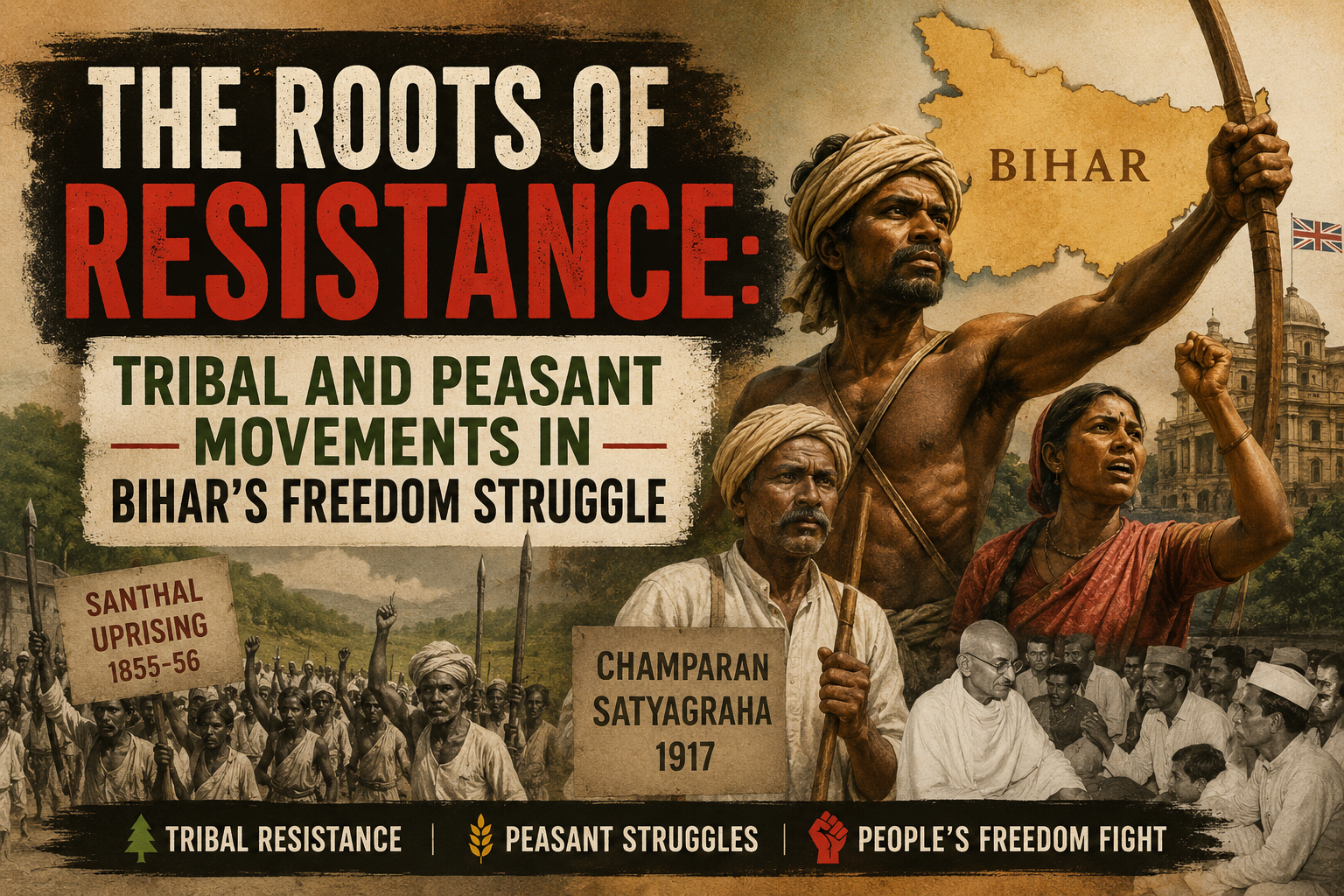
The Roots of Resistance: Tribal and Peasant Movements in Bihar’s Freedom Struggle
Bihar played a major role in India’s history of resistance long before and during the freedom struggle. From the Santhal Uprising to the Champaran Satyagraha, the state saw repeated movements led by tribals and peasants who rose against exploitation, injustice, and colonial pressure. These struggles were not random events. They were connected by a common feeling of protest against forced labour, high rents, moneylender oppression, and loss of land.
This topic is important because it shows how Bihar’s freedom struggle was not limited to elite politics. It also came from villages, forests, and local communities that resisted injustice in their own way.
Historical Movements at a Glance
| Movement | Key Leaders | Core Grievance & Nature |
|---|---|---|
| Santhal Uprising (1855) | Sidhu and Kanhu | Land loss and moneylender exploitation (Militant tribal revolt) |
| Birsa Munda Movement | Birsa Munda | Loss of forest rights and outsider control (Political & spiritual uprising) |
| Champaran Satyagraha (1917) | Mahatma Gandhi | Oppressive tinkathia indigo system (Non-violent mass protest) |
Why These Movements Began
The tribal and peasant resistance movements in Bihar grew out of deep economic and social pressure. Tribals were often pushed out of their land and forest rights. Peasants suffered under landlords, middlemen, and colonial revenue demands. Moneylenders trapped poor families in debt, while officials usually supported the powerful side.
In many places, people were forced into unfair labour systems, illegal taxes, and humiliating treatment. So these movements were not only about politics. They were also about survival, dignity, and control over land and livelihood.
Santhal Uprising, 1855
The Santhal Uprising was one of the earliest and strongest tribal revolts in Bihar and the surrounding region. It began in 1855 under the leadership of Sidhu and Kanhu, along with other Santhal leaders. The Santhals were angry because of exploitation by landlords, moneylenders, and colonial officials.
Their main demands were simple:
- Protection of ancestral land.
- An end to economic exploitation.
- Freedom from unfair economic pressure.
The movement spread quickly because it had the support of ordinary tribal people. Although the British suppressed it with force, the uprising became a powerful symbol of tribal resistance. It also exposed the weaknesses of colonial rule in the countryside.
Birsa Munda Movement
The Birsa Munda Movement was another major tribal resistance that inspired people across eastern India, recognized today by the Ministry of Tribal Affairs as a cornerstone of indigenous history. Birsa Munda became a heroic figure because he combined social reform, tribal identity, and protest against exploitation. His movement was not just political; it also had a spiritual and social reform side.
Birsa called for:
- Tribal unity.
- Freedom from outsider control.
- Protection of land and forest rights.
- Moral renewal among his followers.
The movement showed that tribal resistance had a clear political consciousness. It was not only a reaction to hardship, but also a demand for justice and self-rule. Even though the British arrested Birsa and crushed the movement, his legacy remained deeply influential.
Champaran Satyagraha
The Champaran Satyagraha marked a different phase of peasant resistance. Unlike the Santhal and Birsa movements, it was led by Mahatma Gandhi in 1917 and focused on the problems of indigo cultivators in Champaran. Farmers were forced to grow indigo under the oppressive tinkathia system, which benefited European planters and damaged peasant interests.
The movement became important because it:
- Gave peasants a national platform.
- Brought Gandhi into direct contact with rural Bihar.
- Linked local suffering with the larger freedom struggle.
Champaran was a turning point because it showed that peasant issues could become part of national politics. It also proved that non-violent resistance could challenge colonial injustice effectively.
What Connected These Movements
Although these movements happened in different years and under different leaders, they shared several common features:
- All of them arose from exploitation and injustice.
- All of them were rooted in land, labour, and livelihood.
- All of them expressed local anger against powerful outsiders.
- All of them showed that Bihar’s rural society was politically aware.
The main difference was the method and scale. The Santhal and Birsa movements were more tribal and militant in nature, while Champaran was a mass peasant movement led through satyagraha and peaceful protest.
Importance for Bihar and India
These movements are important because they widened the meaning of resistance. Freedom struggle history is often told through Congress sessions, major leaders, and national campaigns. But Bihar’s tribal and peasant uprisings remind us that protest also came from the ground level.
They helped build:
- Political awareness among rural communities.
- Confidence against systemic injustice.
- A tradition of collective action in Bihar.
They also influenced later movements by proving that ordinary people could challenge authority. In that sense, these struggles were not isolated events. They formed part of a long chain of resistance that shaped modern Bihar and India.
Knowledge Check: Bihar’s Resistance
Loading Quiz…
Frequently Asked Questions (FAQs)
Q1. What were the primary causes of the tribal uprisings in Bihar?
The tribal uprisings, such as the Santhal and Birsa Munda movements, were primarily caused by the systematic loss of ancestral land and forest rights, extreme economic exploitation by colonial landlords, and the oppressive practices of predatory moneylenders.
Q2. How was the Champaran Satyagraha different from earlier tribal revolts?
While earlier tribal revolts like the Santhal uprising were largely militant and localized, the Champaran Satyagraha of 1917 was a non-violent mass protest led by Mahatma Gandhi. It successfully integrated local peasant grievances—specifically the exploitative tinkathia indigo farming system—into the mainstream national freedom struggle.
Q3. What was the core demand of the Birsa Munda movement?
Birsa Munda demanded tribal unity, complete freedom from outsider (Diku) control, the restoration of traditional forest and land rights, and the establishment of self-rule (Munda Raj), alongside a strong push for internal social and moral reform among his followers.